Project Details
Agent Based Modeling & Human Wild Life Behaviour
Project information
- Category: Agent Based Modeling , Computational Modeling , Probability & Statistics
- Contribution: As a Trainee Project Coordinator and Research Assistant at MARC
Project Highlight: Agent Based Modeling & Human Wild Life Behaviour
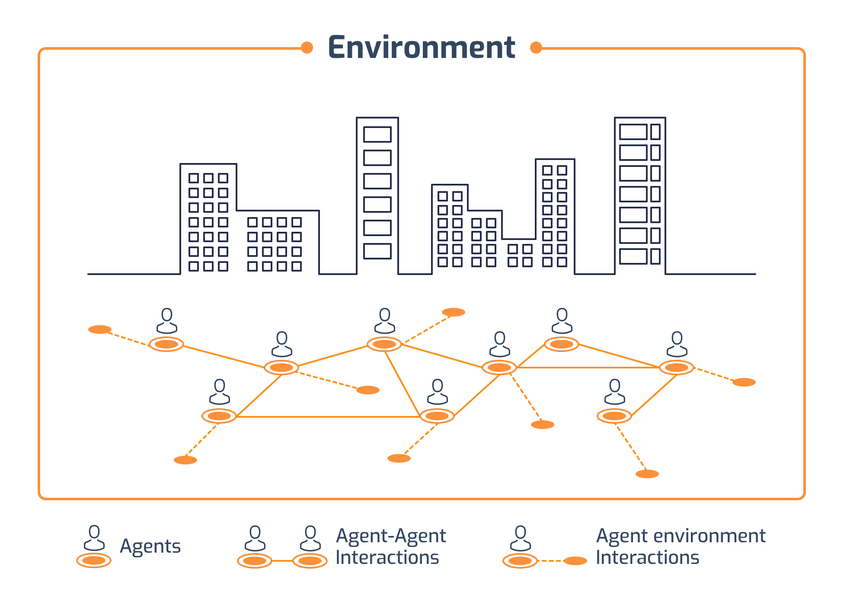
As a Trainee Project Coordinator and Research Assistant at the Multidisciplinary AI Research Center, University of Peradeniya, I contribute to a research project leveraging Agent-Based Modeling (ABM) to advance computational social science and ecological research. My work focuses on evaluating the realism of a previously developed ABM framework for simulating human movement patterns and extending its application to human-wildlife interactions.
Comparative Analysis of Human Movement in Disease Propagation
- Studying the ABM framework developed by a previous research team to simulate the spread of vector-borne diseases (e.g., dengue) and airborne diseases (e.g., COVID-19), with a focus on human movement patterns.
- Conducting comparative analysis between the previous team's ABM and other models, such as Markov models & Random Walk models, to demonstrate that the ABM provides more realistic and nuanced simulations of human movement patterns.
Human-Wildlife Interaction Modeling
- Actively engage in Agent-Based Modeling (ABM) research project, contributing to the development of simulations modeling movement patterns of local primate species (langurs and baboons) and elephants, with a focus on their interactions with human populations; integrated time series data analysis of environmental and behavioral datasets (using Python, pandas, and scipy) to examine how seasonal and environmental factors (e.g., temperature, humidity, precipitation) influence activity patterns, spatial behavior, and movement dynamics.
- Studying human-wildlife interfaces to understand behavioral dynamics and inform ecological conservation strategies for mitigating conflicts.
- Utilizing ABM to generate predictive insights into spatial and temporal patterns of human-animal interactions.
In my role, I conduct comparative analyses to highlight the superior realism of the previous team's ABM framework for human movement patterns, and contribute to realistic simulations for human-wildlife interactions. This work underscores the ABM’s ability to outperform traditional models, delivering actionable insights for human behaviour and wildlife management.